Welcome to today’s topic—bad guys (meant in the non-gender sense/ also applies to ‘he’, ‘him’ etc. I’m not a fan of the plural sounding ‘they’ so apologies to those who are annoyed by this). I had an AI evaluate part of a fiction story and it accused me (a very human interpretation- ha ha) of not giving my bad guy enough redeeming qualities that readers would care if he lived or died during a difficult trek.
I understand the going trend to make all people seem like broken records that just need someone to look past the cracks and presto—-a person worthy of love appears. Kudos to everyone who feels mercy to the bad guy who shows he’s flawed and what—-can’t help that he is rotten? Is mercy about the worthiness of the recipient or the heart of the person witnessing suffering?
Okay, so this isn’t meant to be an essay on who deserves judgement and who receives mercy regardless of the judge’s sentence. My response to the AI (which much to my human annoyance, there is no forum to respond to the AI in the program) is— the point of establishing the bad guy is just that…he is a bad guy and it’s meant to do the opposite: Start with the reader cheering that his life is going down the toilet, then see how his suffering begins to impact his character. Not completely, because in real life, some people head toward improvement, expanding their ability to think about more than just lifting themselves up, but they don’t get to any real change until maybe they’re dying. Not even then. I have noted that people who are dying (or think they’re dying) don’t have this miraculous moment of clarity about life if change wasn’t already in motion. Just a little side tip-bit of advice. Death doesn’t come with a waving sign of ‘last chance to stop being a jerk’.
The subject bad guy doesn’t reach sainthood in the first book of the series (“We Are Survivors” -An American Apocalypse – releasing in a few weeks) but his ability to see himself through the eyes of regret helps him. What the AI doesn’t know (it actually knows nothing but the mosaic of whatever human thought has been published on the internet for it to scrape- does sometimes seem like it’s scraped from the bottom of a cesspool, which doesn’t say much for said humans) is that bad guys are bad and a good many of them stay bad and people who seek to cause no harm to others as a motto in life, do well to steer clear of them or at least not care if they are brought down by other bad guys.
To require a reader to care so much for a bad guy as to make him as safe to hug as the hero, is just not what the world needs right now. Bad actions are bad. Good actions are good. We all know the difference in our hearts, so put aside that people may have their own definition of how either of those look.
As an author, my bad guy is human, but that doesn’t exonerate him from shining the light on his personal choices that hurt and destroy the people around him. Mercy is shown him, not because another character sees the good in him, but because of the heart of the other character.
Real humans do bad things by choice. Everyone has a bad guy in their life who requires that they insulate themselves against as much as possible or just keep praying that he will think of his eternal destiny once in awhile and change the direction he is going in.
Should bad guys illicit only the purest of mercy, not because they’ve earned it, but because of the one fact about them—-they are human and that alone puts a value that the good guys must consider mercy as a response to their predicaments?
What say you reader?
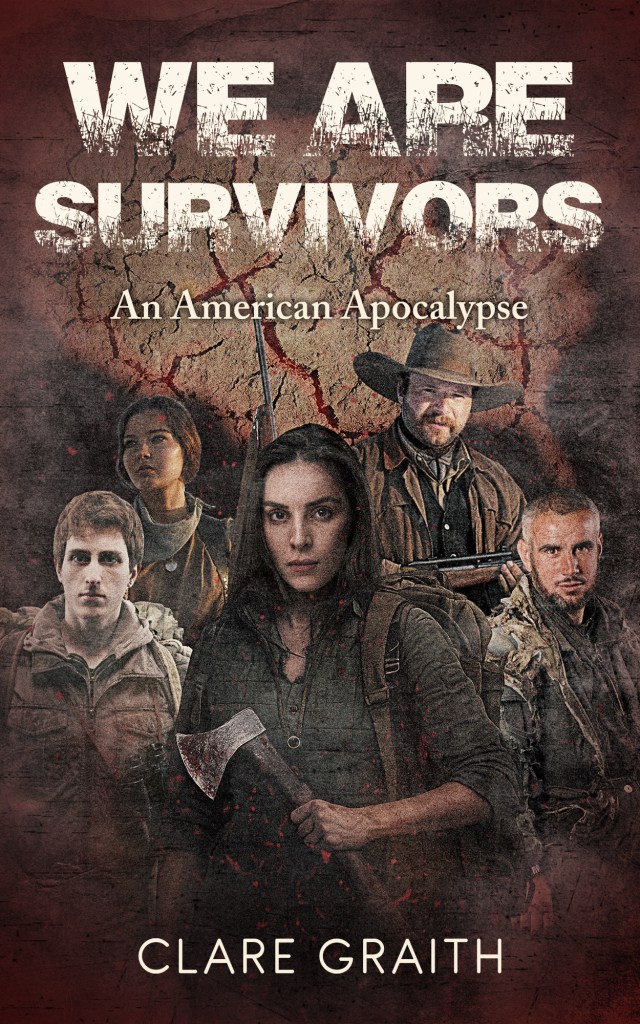
Away on business in the Midwest, Penny isn’t looking for a new husband the day earthquakes ripple across the US. The ground opens up beneath her, and she falls into a hole with a friendly, handsome apple farmer who takes her under his wing.
Her husband, who is presumed to have been at their devastated east coast home, appears on the deceased list. Her twenty-three-year-old twins are on the survivors list at a relief center, which seems like a safe place. Everything will be okay, right? It is until the truth collides with the family’s attempt to reunite against hunger, human predators, and locked down state borders. But their biggest challenge awaits: accepting that who they have become is not who they were before the apocalypse.
“We are Survivors” chronicles a family’s battle not just to survive, but to accept, love, forgive, and re-define who they are to each other.


Leave a Reply